Lebanon (AG-2): Photographs
| These photographs were selected to show the original configuration of this class and major subsequent modifications. For more views see the former NHHC (now Hyperwar) Online Library of Selected Images and the NavSource Photo Archive. |
Click on the small photograph to prompt a larger view of the same image.
|
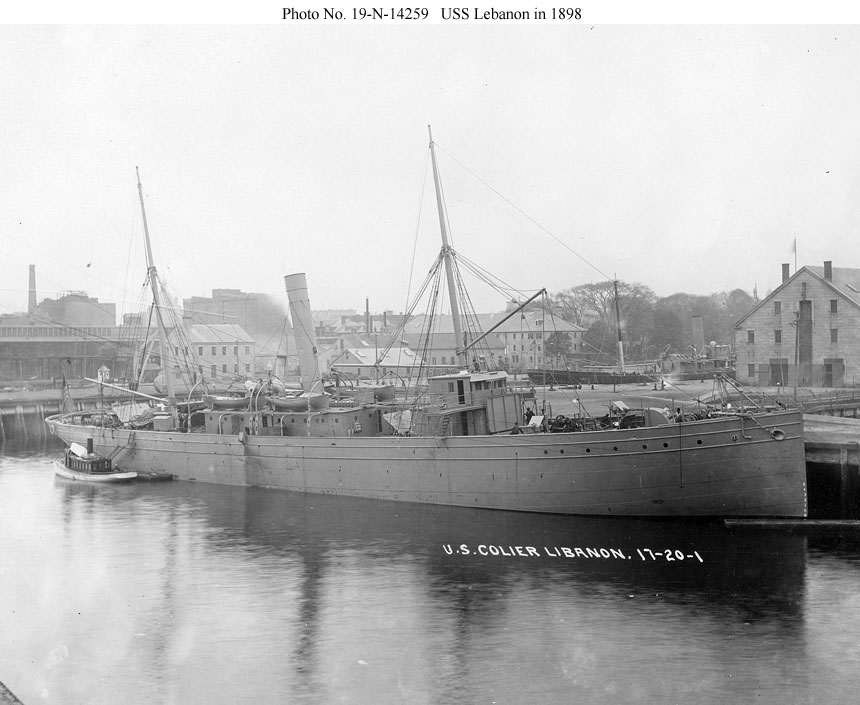
USS Lebanon (1898-1922) At the Boston Navy Yard in 1898, probably when preparing for Spanish-American War service. The ship had been built for the Philadelphia and Reading Railroad to move coal along the East Coast, and because she was designed to tow coal barges while carrying coal in her holds she was sometimes called a "big steam tug." Note the open hatch covers forward and aft. Photo No. 19-N-14259 Source: U.S. National Archives, RG-19-N box 1. |
 |
|
USS Lebanon (1898-1922) Shown "talking at sea" with signal flags off Cuba during the Spanish American war. The contemporary handwritten caption explains that "As the vessels seldom come within speaking distance at sea, the flags tell the news, and pass the orders over the miles of intervening water." Lebanon served primarily as a collier during the 1898 war. Photo No. NH 105292 Source: U.S. Naval History and Heritage Command. |
 |
|
USS Lebanon (1898-1922) Photographed in the Hudson River in October 1912 during that year's Presidential Naval Review. Photo No. NH 59450 Source: U.S. Naval History and Heritage Command. |
 |
|
USS Lebanon (1898-1922) In port with "R" type submarines alongside, circa 1919. Among the boats present are USS R-3 (Submarine # 80) - 2nd from left; and USS R-9 (Submarine # 86) - 2nd from right. Photo No. NH 77275 Source: U.S. Naval History and Heritage Command. |
 |
|
USS Lebanon (AG-2) With a gunnery target alongside circa 1920-1921. After 1911 the ship's primary function was towing and repairing gunnery targets for the Atlantic Fleet. Photo No. None Source: Shipscribe. |
 |
|
USS Lebanon (AG-2) A gunnery practice target undergoing repair or assembly alongside USS Lebanon, circa 1920. Photo No. NH 77277 Source: U.S. Naval History and Heritage Command. |
 |